
California Hiring System — Identifying Systemic Barriers (Phase 1) 2022–2023
Cross-agency research & problem framing
Building a shared understanding of state-level recruiting and hiring
Decision at Stake
The State of California consistently had thousands of job openings, but the hiring process was slow, opaque, and frustrating for both candidates and staff.
Governor Newsom directed GovOps to transform state recruiting and hiring, but leadership lacked clarity on what was causing the problems. Before making changes, they needed to understand: Where was the system actually breaking down — and why?
Context
CalHR and SPB — the agencies overseeing state hiring — partnered with the Office of Data and Innovation (ODI) to conduct cross-agency research.
The goal was not to validate assumptions, but to surface the real constraints, breakdowns, and misalignments preventing the hiring system from functioning effectively.
My Role
I served as ODI project lead and lead researcher, managing vendor relationships, partner coordination, and expectations with senior leadership.
My role included conducting interviews, debriefs, synthesis, and guiding the storyline for final presentation to Cabinet-level leadership.
Research Approach (in Service of Decisions)
Rather than starting with proposed solutions, we focused on building a comprehensive, ground-truth view of how hiring actually worked across departments — from policy to practice.
We grounded ourselves in statute, policies, org charts, data, technologies, and process documentation — then validated against lived experience through interviews and workshops.
Methods & Research Rigor
- Leadership interviews with CalHR, SPB, and state departments to understand rules and constraints
- Workshops with HR staff and hiring managers to reveal how rules were applied day-to-day
- Interviews with recently hired employees across departments to understand candidate experience
- Process mapping and system visualization to identify breakdowns and opportunity areas
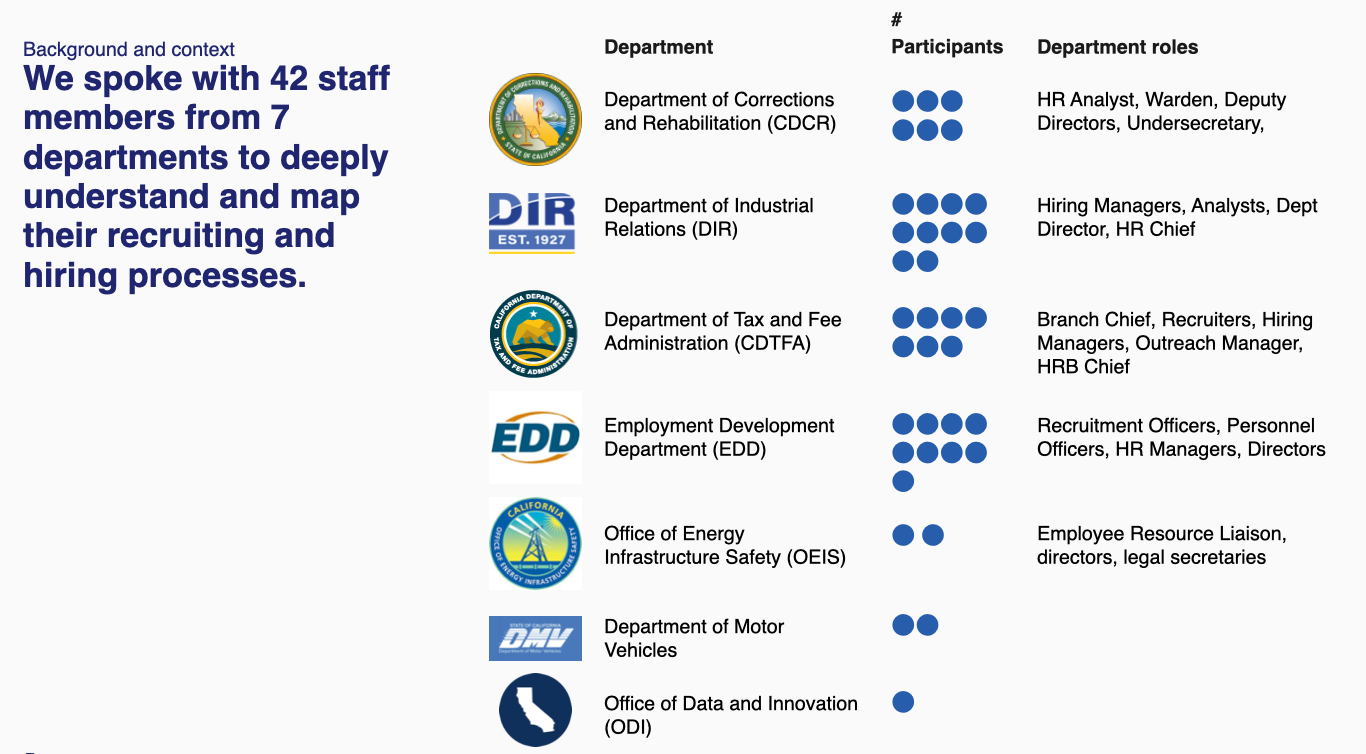
Scope: 12 weeks | 67 people across 13 departments | 4 UX researchers, 1 PM, 1 engineer, 1 content designer
Key Insights
- Recruiting and hiring processes were surprisingly similar across departments: Despite perceptions of uniqueness, departments shared high-level processes and challenges. This revealed opportunity to reduce silos and develop standardized best practices that could benefit many departments.
- Many challenges on the candidate side were also felt by staff: Candidates and HR staff were often frustrated by the same things, with shared root causes. Improvements to candidate experience would benefit staff over time.
How It Was Used
The research created a series of tools that translated findings into actionable recommendations:
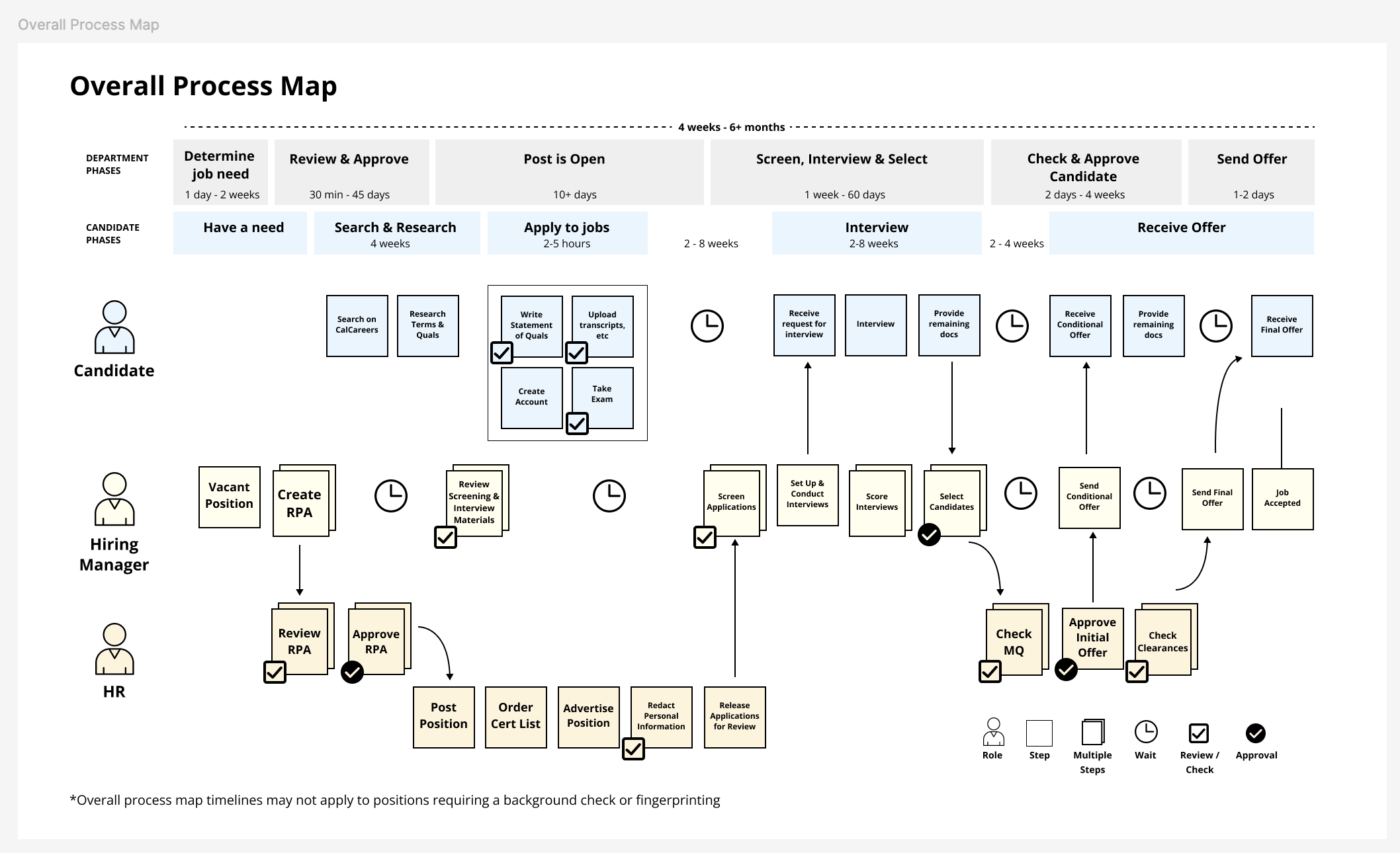
- Process maps: Department-specific maps detailing timeframes, approvals, roles, policies, technologies, and documents. A high-level map illustrated the 5-phase hiring process shared across departments.
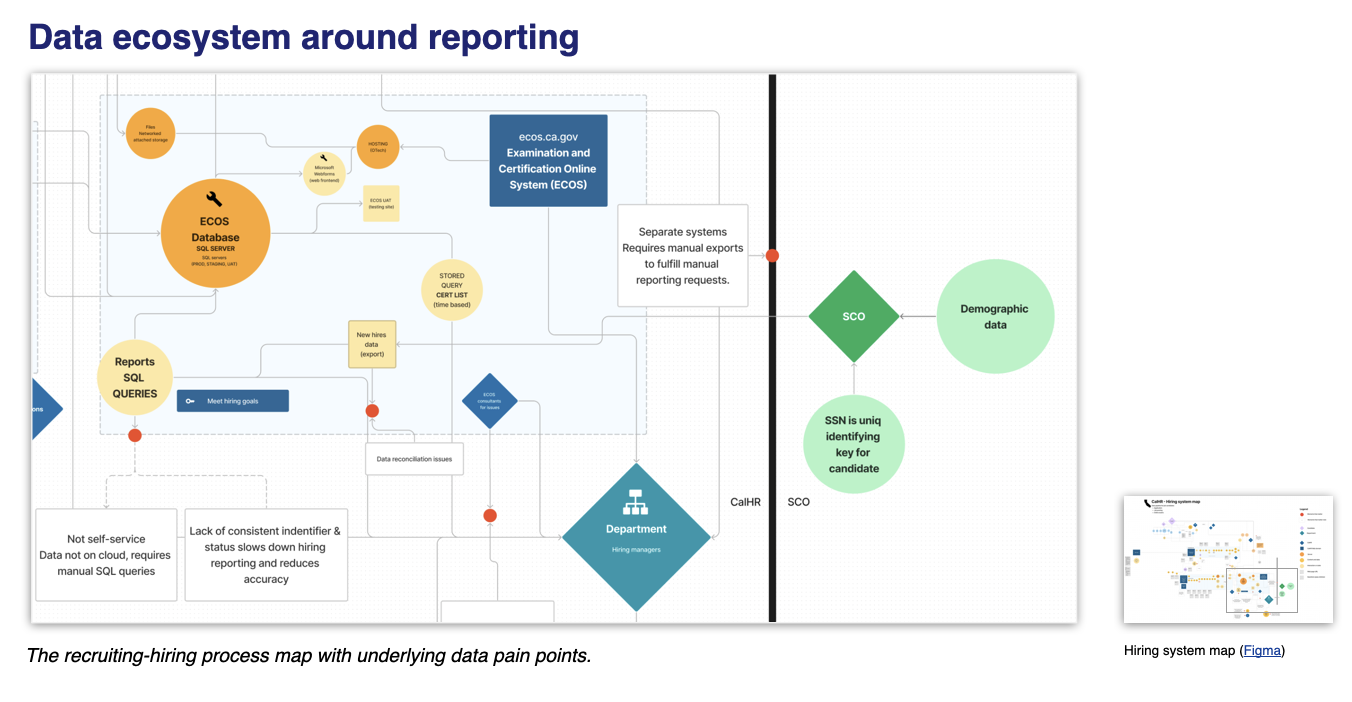
- System visualizations: Ecosystem, communication flow, data, and stakeholder maps that provided holistic views and helped prioritize opportunities.
- Areas of opportunity: Actionable improvements identified for both candidates and HR staff.
This became phase 1 of a multi-phase approach to understanding California's hiring system and implementing changes rooted in a clear understanding of root causes.
What Leadership Learned
- The hiring system's problems were not department-specific — they were systemic
- Shared pain points created opportunity for shared solutions
- Fixing candidate experience would reduce burden on HR staff
Perhaps most importantly, the work spurred unprecedented conversations across leadership in CalHR, SPB, and GovOps — creating a common understanding of problems, root causes, and the path forward.