
Small Business Procurement — Removing Barriers to Participation 2020–2021
Policy, process & equity research
Understanding and addressing barriers small businesses face in state contracting
Decision at Stake
California committed to increasing small business participation in state procurement, but participation rates remained low — particularly among businesses owned by women, minorities, and disabled veterans.
The decision was whether barriers were primarily awareness-related (marketing and outreach) or structural (policy, process, and systemic constraints). This distinction would fundamentally shape where leadership invested resources.
Context
State procurement processes were designed with large vendors in mind. Small businesses faced certification requirements, bid preparation complexity, and payment timelines that created significant barriers to entry.
ODI partnered with DGS (Department of General Services) to understand where the procurement system was breaking down for small businesses — and which interventions would meaningfully improve participation.
My Role
I led research strategy and coordination, working with DGS, small business advocates, and procurement staff to surface where policy, process, and practice created unintended barriers.
My role included conducting interviews with small business owners, synthesizing findings across stakeholder perspectives, and helping leadership distinguish between symptoms and root causes.
Research Approach (in Service of Decisions)
Rather than assuming the problem was awareness or outreach, we focused on understanding the full journey small businesses experience when attempting to work with the State — from discovery to contract award to payment.
We treated policy and process as design problems, identifying where systems optimized for large vendors inadvertently excluded smaller ones.
Methods & Research Rigor
- In-depth interviews with small business owners who attempted to bid
- Interviews with businesses that successfully won contracts
- Stakeholder interviews with procurement staff and advocates
- Process mapping of certification, bidding, and payment flows
- Policy analysis identifying structural barriers
- Comparative analysis of other states' small business programs
Key Themes from State Procurement Staff
1. SB/DVBE First Policies Don't Guarantee Results
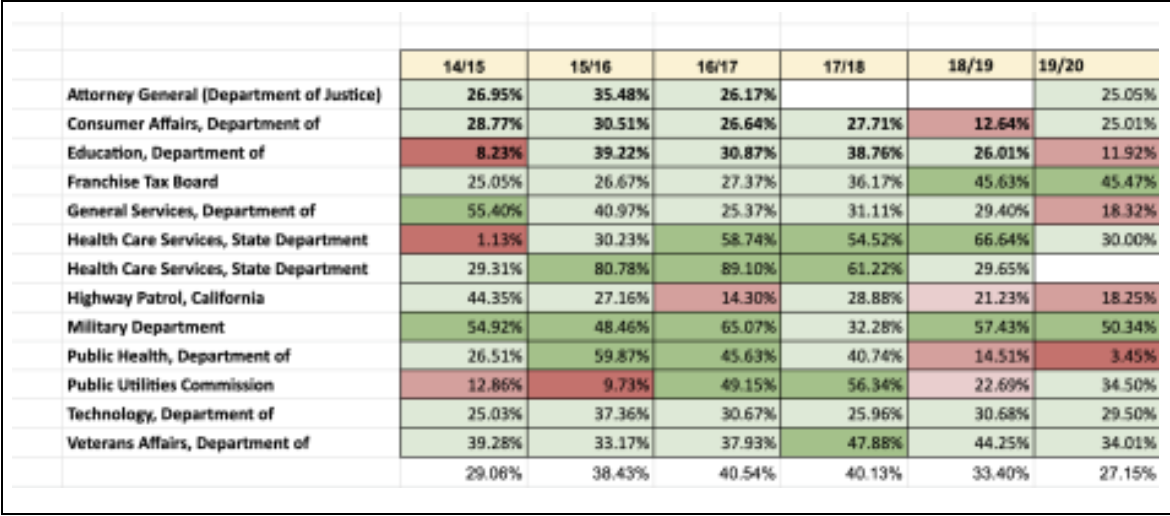
We compiled and cleaned six years of consolidated annual report data, splitting departments into those with and without formal SB-first policies. Among the 13 departments with an SB-first policy, participation rates weren't dramatically higher — in fact, departments without such policies had higher SB participation on average in recent years.
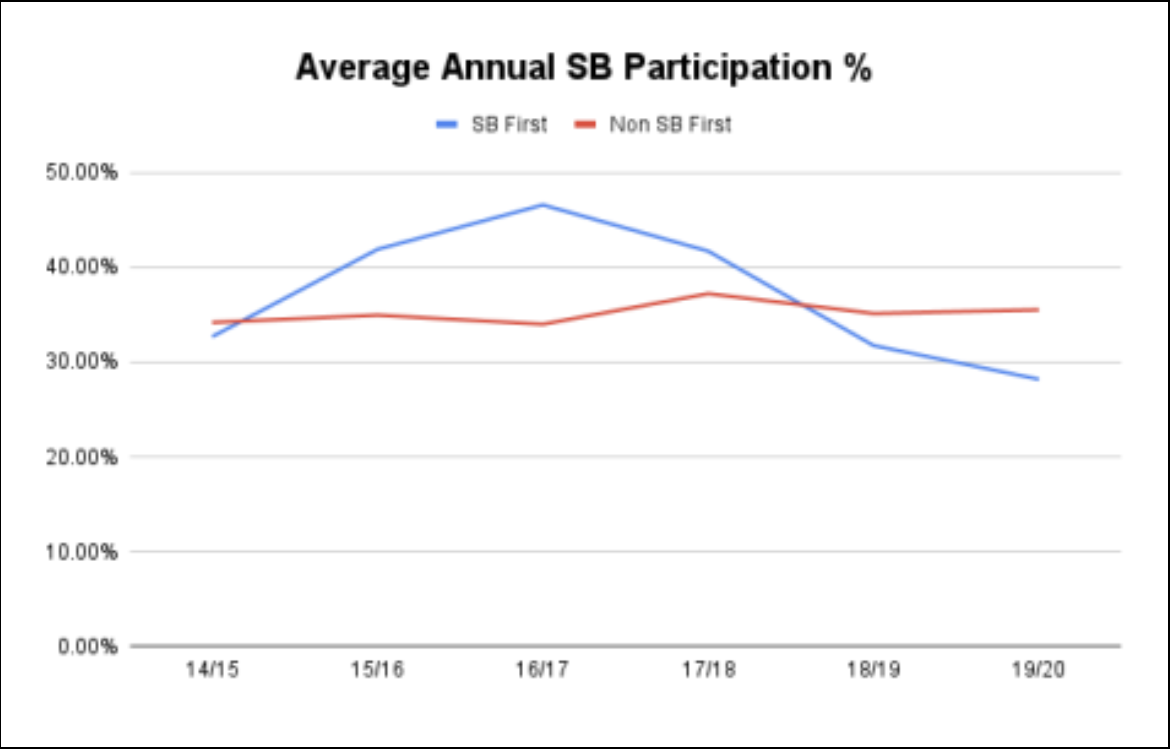
Year-over-year analysis showed departments with SB-first policies performed higher on average until 2016/2017, but have progressively decreased since then.
2. Improvement Plans Don't Always Improve Participation
We reviewed two years of corrective action reports and found wide variance in detail and quality. Most reports lacked concrete, measurable goals for increasing SB participation rates.
3. Most Departments Don't See SB Procurement as Mission-Critical
A recurring issue: most departments don't view small business engagement as critical to their mission. SB advocate positions were rarely full-time dedicated roles, and the 25% SB participation goal was secondary to departmental business needs. Non-procurement staff often viewed SB procurement as a chore with extra risks and administrative overhead.
4. High-Performing Departments Integrate Procurement into Their Mission
Departments with consistently high SB participation rates shared common characteristics: strong leadership support, alignment between SB participation and department mission, dedicated SB advocate positions, and strategic intentionality about maintaining high participation.
5. Procurement and Program Staff Often Have Competing Priorities
Departments without leadership support experienced tension between procurement and program staff. While procurement staff strived for equitable, diverse processes, program staff focused on getting what they needed regardless of how. We also observed procurement staff being brought in late to processes and having to justify SB engagement benefits.
6. Successful Collaboration Models Exist
Some departments demonstrated effective collaboration: designated "pre-procurement" check-ins between procurement and program staff, proactive fulfillment of program needs through early strategic discussions, and well-equipped staff with low turnover and deep institutional knowledge.
7. Procurement Staff Aren't Fully Equipped to Support Small Businesses
Buyers and procurement staff reported issues with incomplete or incorrect SB bids. However, many acknowledged the bid process is prohibitively complex — especially for businesses new to state contracting, with challenges varying widely between departments.
Bright Spots: Some Staff Are Actively Improving the Experience
We found procurement officers taking extra steps to support small businesses: communicating early, providing clearer guidance, and making outreach more thorough. Some SB advocates have invested significantly in understanding how to make the procurement process less challenging.
How It Was Used
Research findings informed multiple levels of intervention:
- Policy recommendations: Identified specific policies that could be modified to reduce barriers without compromising accountability
- Process improvements: Simplified certification pathways and bid preparation guidance
- Payment reform exploration: Investigated accelerated payment options for small business contractors
- Training and support: Developed targeted resources for businesses new to state procurement
What Leadership Learned
- Low participation was not primarily an awareness problem — it was a structural design problem
- Processes optimized for large vendors inadvertently exclude smaller ones, even when policy intends inclusion
- Payment timelines that work for established businesses create unsustainable cash flow barriers for small businesses
- Equity in procurement requires rethinking process design, not just outreach and marketing
- Small changes to policy and process can have disproportionate impact on participation when they address actual barriers